
Podcast: Play in new window | Download
Subscribe: Spotify | Email | RSS | More
In this Diving Deep episode, Dr. Robert Pearl and Jeremy Corr dissect two issues that are often discussed separately but are deeply intertwined: how Americans can live longer, healthier lives and how the nation can make healthcare more affordable.
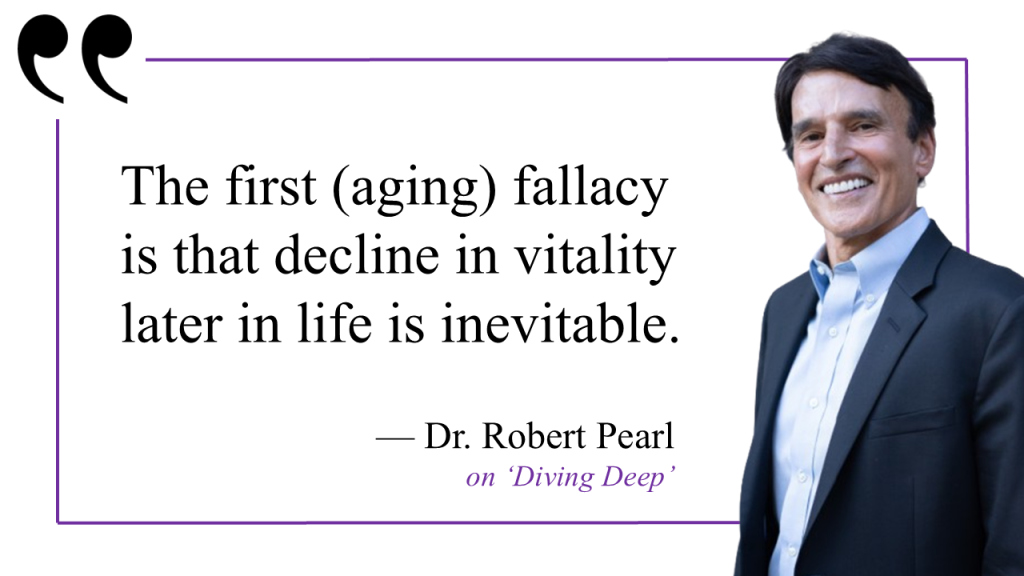
The conversation begins with longevity. As interest in lifespan and “healthspan” grows, Dr. Pearl challenges three widely held beliefs that, in his view, are holding Americans back. First, the idea that physical and cognitive decline is inevitable with age. New research suggests that nearly half of older adults improve over time, particularly when they maintain a positive outlook and stay physically and mentally active. Second, the belief that longevity can be “hacked” through supplements, peptides and other quick fixes. Despite a $50 billion market and widespread adoption, Pearl explains that most of these interventions lack strong clinical evidence in humans. And third, the assumption that prevention can wait until middle age. Updated cardiovascular guidelines show that earlier screening and intervention, particularly around LDL cholesterol, can dramatically reduce long-term risk.
From there, the discussion shifts to the financial side of healthcare. Pearl argues that improving population health is the most effective way to reduce costs, but that meaningful change will also require a fundamental redesign of how care is delivered. Drawing on behavioral research, he introduces a central concept: healthcare leaders tend to solve problems by adding more resources (staff, beds, technology) when better outcomes often require subtraction first.
The second half of the episode applies this “subtraction before addition” framework across the healthcare system. In outpatient care, Pearl describes how the traditional small physician office has become increasingly inefficient in an era dominated by chronic disease and administrative complexity. He proposes larger, integrated models that share staff, leverage generative AI and shift from calendar-based visits to continuous, need-based care. In emergency departments, he outlines how segmenting patients by clinical severity could reduce wait times, improve outcomes and lower costs by treating low-risk cases through primary care pathways. And in inpatient settings, he points to hospital-at-home programs as a way to safely care for a significant share of patients at lower cost and with better outcomes.
Taken together, this episode teaches that Americans can extend both lifespan and healthspan by rejecting outdated assumptions and focusing on proven behaviors. At the same time, healthcare affordability will not improve by continuing to add more of the same. It will require eliminating inefficiencies, redesigning care delivery and replacing outdated models with ones better suited to modern medicine.
For more, tune into this month’s episode and check out the links below.
Helpful links
- New Studies Show Americans Are Thinking About Longevity All Wrong (Forbes)
- The More We Add To U.S. Healthcare, The Worse It Gets (Forbes)
- Monthly Musings on American Healthcare (RobertPearlMD.com)
* * *
Dr. Robert Pearl is the author of “ChatGPT, MD: How AI-Empowered Patients & Doctors Can Take Back Control of American Medicine.” Fixing Healthcare is a co-production of Dr. Robert Pearl and Jeremy Corr. Subscribe to the show via Apple, Spotify or wherever you find podcasts. Join the conversation or suggest a guest by following the show on X and LinkedIn.