
Podcast: Play in new window | Download
Subscribe: Spotify | Email | RSS | More
In this week’s episode of Medicine: The Truth, hosts Jeremy Corr and Dr. Robert Pearl dig for the facts beneath healthcare’s biggest headlines. Today’s show opens with a problem more Americans are facing every year: rising out-of-pocket costs and the growing demand that patients pay before they receive care.
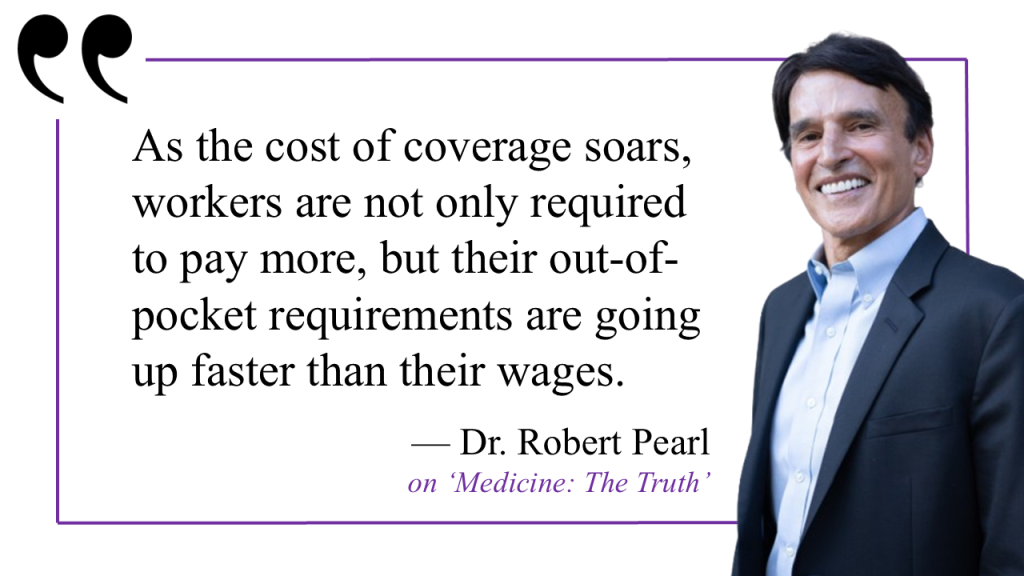
Pearl explains that the listener’s concern is increasingly the rule, not the exception. Total health costs per employee now average more than $20,000 a year, including premiums and out-of-pocket obligations. With projections for next year showing costs rising another 9% to 11%, workers are likely to shoulder an even greater financial burden.
But higher deductibles are only part of the problem. Doctors and hospitals are increasingly asking patients to pay out-of-pocket costs in advance before scheduling non-emergency procedures. Pearl says 92% of U.S. healthcare providers now either strongly encourage or require advance payment, up from 81% a year earlier. That means a patient who needs a hernia repair, gallbladder surgery, ACL repair or other painful but non-emergency procedure may be asked to pay thousands of dollars before care can proceed.
For Pearl, this is a warning sign of a larger affordability crisis. As premiums, deductibles, drug prices and hospital charges rise, medical costs are increasingly being treated like a hot potato, passed from the federal government to states, from insurers to employers and from employers to workers.
Here are the other major storylines from episode 111:
- President Trump has nominated Dr. Heidi Overton to lead the FDA following Marty Makary’s departure. Her support for scaling back childhood vaccine recommendations has already drawn concern from Senate Health Committee chair Dr. Bill Cassidy.
- The battle between politics and science is expanding. Pearl points to HHS hiring an Army doctor to investigate unsupported claims that thousands of U.S. service members died after receiving COVID vaccines, despite Pentagon reports finding no vaccine-related deaths.
- Personalized mRNA cancer vaccines remain one of the most exciting areas in oncology. Early Moderna and Merck data in melanoma are promising, though the full results have not yet been published.
- A new FDA-approved drug for advanced pancreatic cancer has generated enthusiasm because it extended life in patients who had already failed chemotherapy. But the drug is expected to cost about $480,000 a year.
- The Lone Star tick is spreading beyond the Southeast into New England and the upper Midwest. Unlike the deer tick associated with Lyme disease, the Lone Star tick can trigger a potentially dangerous allergic reaction to red meat.
- Measles cases are rising at a record-setting pace in 2026, with preventable deaths occurring among unvaccinated individuals. Falling immunization rates put the United States at risk of losing its measles elimination status.
- Employers are bracing for the largest healthcare cost increase in two decades. Some are responding by dropping GLP-1 coverage, limiting spousal coverage or shifting more costs to workers.
- New evidence from Amsterdam supports the value of long-term primary care relationships. Patients who saw the same clinician for 15 to 20 years had lower odds of emergency hospital admission, and cost reductions appeared strongest among those with relationships lasting 10 to 15 years.
- In a comparison of tirzepatide and semaglutide for weight loss, Pearl says tirzepatide produced greater weight loss and slightly better A1c reduction, while semaglutide had fewer reported side effects. He emphasizes that both drugs are highly effective and that cost is often the main reason patients stop taking them.
The episode closes with Pearl’s provocative thoughts on generative AI. He says the time has come for healthcare professionals to stop denying its clinical power.
Pearl acknowledges the existential risks associated with advanced AI, but says the same capabilities also create enormous opportunities to improve outcomes, save lives and make care more accessible and affordable. American medicine, he argues, is not performing well enough to defend the status quo. Misdiagnoses, preventable medical errors and poor chronic disease control continue to kill hundreds of thousands of Americans each year.
Meanwhile, patients are already turning to ChatGPT, Claude, Gemini and other large language models when they have symptoms or medical questions, especially when doctors’ offices are closed or appointments are days or weeks away. Pearl says the question is no longer whether generative AI will provide clinical expertise to patients. As both a physician and a patient, he hopes healthcare professionals seize the opportunity before someone else does.
Tune in to hear the full discussion and subscribe to Medicine: The Truth for more fact-based analysis of the medical, scientific and policy stories shaping American healthcare.
* * *
Dr. Robert Pearl is the author of “ChatGPT, MD: How AI-Empowered Patients & Doctors Can Take Back Control of American Medicine” about the impact of AI on the future of medicine.
Fixing Healthcare is a co-production of Dr. Robert Pearl and Jeremy Corr. Subscribe to the show via Apple, Spotify or wherever you find podcasts. Join the conversation or suggest a guest by following the show on X and LinkedIn.