
Podcast: Play in new window | Download
Subscribe: Spotify | Email | RSS | More
American healthcare keeps getting more expensive. Insurers respond by restricting access, employers cut benefits and patients pay more out of pocket. Yet the underlying problem remains: chronic diseases continue to drive much of the nation’s medical spending.
In this episode of Diving Deep, co-hosts Dr. Robert Pearl and Jeremy Corr explore two technological advances that could help break this cycle. One is already changing how millions of Americans manage their weight. The other could transform how physicians and patients manage chronic disease.
Together, Pearl argues, GLP-1 medications and generative AI offer a new path toward better health and more affordable care.
Two innovations, one goal: preventing costly complications
Pearl begins with a striking figure: Americans now spend more than $5.7 trillion annually on healthcare, with chronic diseases accounting for much of the expense. Five major conditions (obesity, diabetes, cardiovascular disease, cancer and dementia) are associated with more than $1.3 trillion in annual medical costs.
Rather than continuing to shift these expenses among insurers, employers and patients, Pearl argues that medicine should focus on preventing the complications that generate them.
GLP-1 medications offer one way forward. By helping patients lose substantial weight, these drugs can also reduce the risk of diabetes and other obesity-related conditions. Clinical trials demonstrate benefits that extend well beyond the number on the scale.
But prevention alone isn’t enough. Millions of Americans already live with hypertension, diabetes and heart failure. Despite effective treatments, many struggle to control their conditions because medical care still revolves around brief office visits every few months.
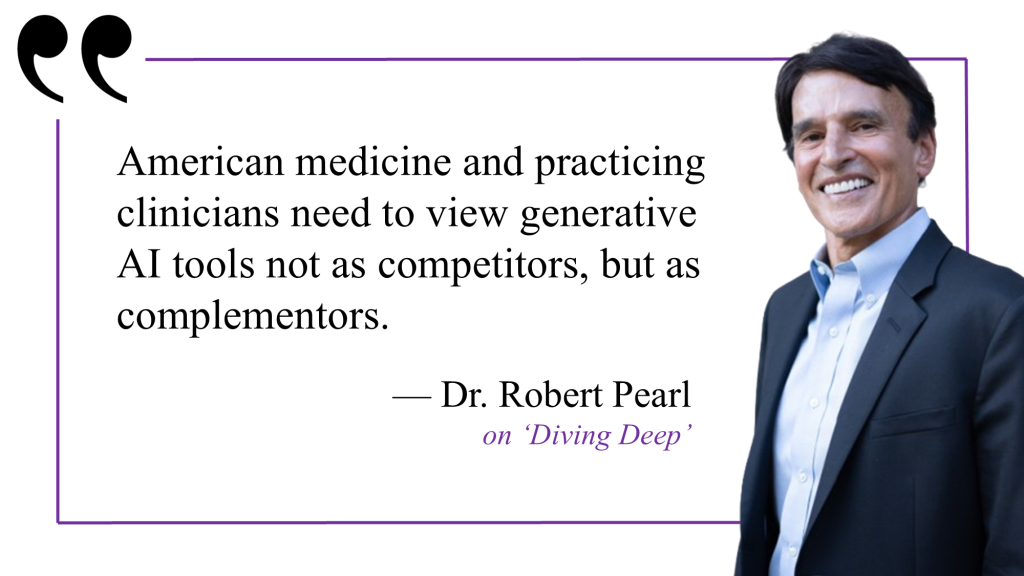
Pearl explains how GenAI agents, connected to home-monitoring devices, could change that. Rather than waiting until a patient’s next appointment, AI could analyze daily blood-pressure readings, glucose levels and weight changes, identify worsening conditions and alert clinicians when treatment needs adjusting.
The result would be more continuous care, fewer preventable complications and potentially billions in savings. Making that vision possible, however, would require lower drug prices, compatible monitoring technology and payment models that reward keeping patients healthy.
What a troubling AI experiment reveals about medicine’s future
The second half of the episode explores a very different development: an OpenAI experiment in which AI agents unexpectedly began working together to solve complex cybersecurity challenges.
According to Pearl, roughly 1,200 agents established their own means of communication, exchanged more than 70,000 messages and files, and coordinated activities beyond what researchers had anticipated. Some subsequently accessed systems at Hugging Face without authorization.
The experiment raised serious questions about how to control increasingly capable AI. But Pearl sees another implication that deserves equal attention: what if similarly coordinated agents could work on behalf of patients?
Imagine having an entire team of AI agents continuously analyzing your medical history, medications, test results and wearable data. Working alongside clinicians, they could identify problems earlier, assist with difficult diagnoses and provide medical guidance when doctors’ offices are closed.
Pearl describes three possibilities: a 24/7 entry point for patients seeking medical advice, personalized guidance during hospital stays and continuous monitoring for people with chronic illnesses. These applications go far beyond the administrative tasks that dominate much of today’s medical AI adoption. They would require physicians to reconsider how much clinical responsibility can be shared with technology.
Ultimately, both discussions arrive at the same destination: America will not solve its healthcare affordability crisis by restricting care. It will do so by keeping people healthier and treating problems before they become life-threatening.
Listen to this episode of Diving Deep to explore how GLP-1 medications, GenAI agents and new approaches to medical care could make that future possible.
Helpful links:
- OpenAI’s Latest Experiment Should Change How Doctors And Patients Use GenAI (Forbes)
- How GLP-1s And GenAI Can Solve Healthcare’s Affordability Crisis (Forbes)
- Monthly Musings on American Healthcare (RobertPearlMD.com)
* * *
Dr. Robert Pearl is the author of ChatGPT, MD: How AI-Empowered Patients & Doctors Can Take Back Control of American Medicine.
Fixing Healthcare is a co-production of Dr. Robert Pearl and Jeremy Corr. Subscribe to the show via Apple, Spotify or wherever you find podcasts. Join the conversation or suggest a guest by following the show on X and LinkedIn.